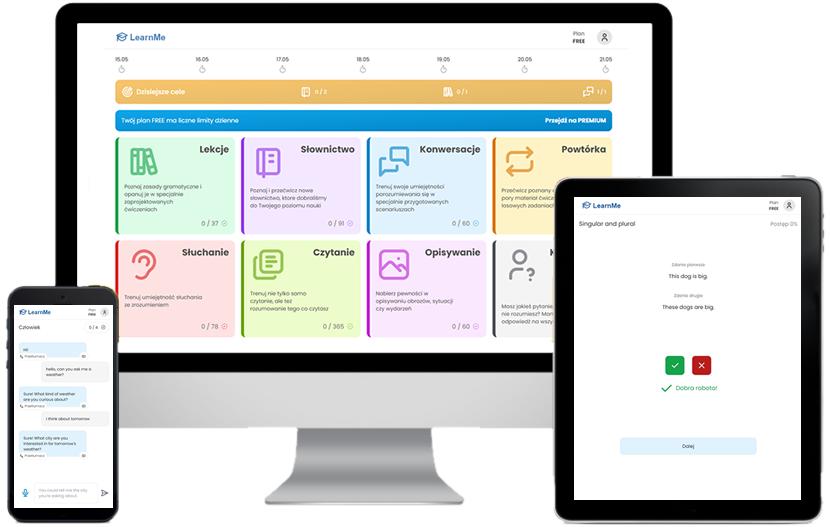
Available lessons
A0
Personal pronouns
Personal pronouns
Learn the personal pronouns: I, you, he, she, it, we, they and their basic use.
A0
The verb to be – am, is, are
The verb to be - am, is, are
The most important English verb. Learn when to use am, is and are.
A0
Greetings and introductions
Greetings and introductions
Learn basic phrases: how to greet, say goodbye and tell someone your name.
A0
Numbers 0-20
Numbers 0-20
Master the names and spelling of numbers from zero to twenty – a foundation for telling the time, dates and shopping.
A0
Numbers 21-100
Numbers 21-100
Learn numbers from 21 to 100, tens and full tens, and their written form.
A0
Possessive adjectives
Possessive adjectives
Learn my, your, his, her, its, our, their – how to show who something belongs to.
A0
Family members
Family members
Learn the names of family members in English and describe a simple family.
A0
Colours and common objects
Colours and common objects
Learn colours and the names of everyday objects.
A0
Food and drink
Food and drink
Learn the names of food, drinks and simple phrases for shopping and restaurants.
A0
Countries and nationalities
Countries and nationalities
Learn country names, nationalities and basic questions about origin.
A1
Days, months and seasons
Days, months and seasons
Learn the names of days, months and seasons – essential for dates and weather.
A1
Question words
Question words
What, Where, Who, How, Why, When – the basic words for asking questions in English.
A1
Building questions
Building questions
Learn word order in questions and when to use do/does and the verb to be.
A1
Present Simple - third person singular
Present Simple - third person singular
Learn when and how to add -s/-es to verbs in the third person singular.
A1
Prepositions of place
Prepositions of place
Learn the prepositions of place: in, on, at, under, behind, in front of, next to, between.
A1
Prepositions of time
Prepositions of Time
Master the rules for using the prepositions "at", "on" and "in". Find out which fits specific hours, days of the week, months or seasons, so your statements about time are always precise.
A1
Adverbs of frequency
Adverbs of Frequency
Learn to describe your routine with words like "always", "often" or "never". Find out where in the sentence to place the adverb to correctly specify the intensity of your actions.
A1
How much / how many?
How much? / How many?
Learn the key difference between asking about quantity and number. Learn when to use "how much" with uncountable nouns and when to use "how many" for things you can easily count.
A1
Verb + -ing form
verb + -ing
Learn how to combine two verbs in one sentence. Master the constructions after preference words like "love", "like" or "finish", and learn to correctly build sentences about your hobbies.
A1
Imperative
Imperative
Learn to give commands, instructions and advice in a simple way. Find out how to form affirmative and negative forms without a subject, which is crucial in everyday messages and orders.
A1
Indefinite quantity
Some / Any
Master the rules for talking about an indefinite quantity of items and substances. Learn why "some" dominates in affirmatives and "any" in questions and negatives, and how these words change the sound of requests.
A2
To have, to possess
have got / has got
Learn to describe possession, physical appearance and family relationships. Master the "have got" forms for all persons and learn how to ask questions about what your interlocutors have.
A2
There is / there are
There is / There are
Discover the simplest way to describe places and to report the existence of things around you. Learn how to match the form to the number of items and how to ask about the availability of things in a given room.
A2
These are / Those are
These are / those are
Learn to point to groups of items within reach or in the distance. Master the use of plural demonstrative pronouns to specify precisely which things you are talking about.
A2
Singular and plural
Singular and plural
Learn the rules for forming plurals of nouns. Besides the standard "-s" ending, find out how to handle exceptions and irregular forms that are essential for correct communication.
A2
Complement
Complement
Learn to build complete sentences that precisely describe the subject's qualities. Find out how to use complements after linking verbs to make your descriptions of people and situations richer and clearer.
A2
Comparison of adjectives
Comparison of adjectives
Learn to compare the qualities of things and people. Master forming the comparative and superlative for both short and long adjectives, so you can easily judge what is better or cheapest.
A2
Present Simple
Present Simple
Master the most important tense for describing facts, habits and permanent life situations. Learn how to add the "-s" ending in the third person singular and how to ask about daily routines.
A2
Present Continuous
Present Continuous
Learn to talk about what is happening right now. Discover the construction with the "be" operator and the "-ing" ending, which will let you describe current events and your temporary life situations.
A2
Past Simple
Past Simple
Learn the basic tool for talking about the past. Learn to form regular verbs and get to know the most popular irregular forms, so you can freely report completed events.
A2
Future Simple
Future Simple
Master the use of "will" to express spontaneous decisions, promises and predictions about the future. Learn how to easily plan and declare your intentions in conversations with other people.
A2
Saxon genitive
Saxon Genitive
Learn to express possession in the most natural way. Find out how to add an apostrophe and the letter "-s" to nouns to show who items belong to or what family relationships are.
A2
Countable and uncountable nouns
Countable and Uncountable Nouns
Understand the division into things you can count and substances treated as a whole. Learn to match verbs and quantity determiners to the noun type - the key to correct grammar.
B1
Present Simple and Present Continuous
Present tenses (comparison)
Learn to instantly distinguish permanent and routine situations from temporary ones. Master the structure of both tenses and find out which verbs should not be used in the continuous form.
B1
Passive and active voice
Passive and Active Voice
Learn how to change the sentence structure to focus on the object or the action itself rather than the doer. Master forming the passive voice, which is essential in formal and technical style.
B1
Conditionals
Conditionals
Learn to build "if..., then..." sentences. Master different degrees of probability - from scientific facts and real plans to pure speculation and dreams about almost impossible situations.
B1
Past tenses (comparison)
Past Simple i Past Continuous
Master combining two past tenses in one sentence. Learn how to describe actions that were interrupted by other sudden events, and how to create background for your stories about the past.
B1
Modal verbs
Modal verbs
Learn the wide spectrum of uses for verbs like "must", "should" or "might". Learn to express requests, commands, advice and the degree of probability of various future events.
B1
Actions continuing until now
Present Perfect Continuous
Learn to talk about actions that started in the past and continue uninterrupted to the present. Master the construction emphasizing the duration of a process and its visible, fresh effects.
B2
Advanced sentence structures
Advanced sentence structures
Reach a higher level of fluency by learning stylistic inversion and formal constructions. Learn to change word order to emphasize the most important information and sound like a professional speaker.
These are only 43 of 61 lessons available in the app!
Discover all our lessons and practice the material in interactive exercises designed for each topic — make progress in your language skills!